
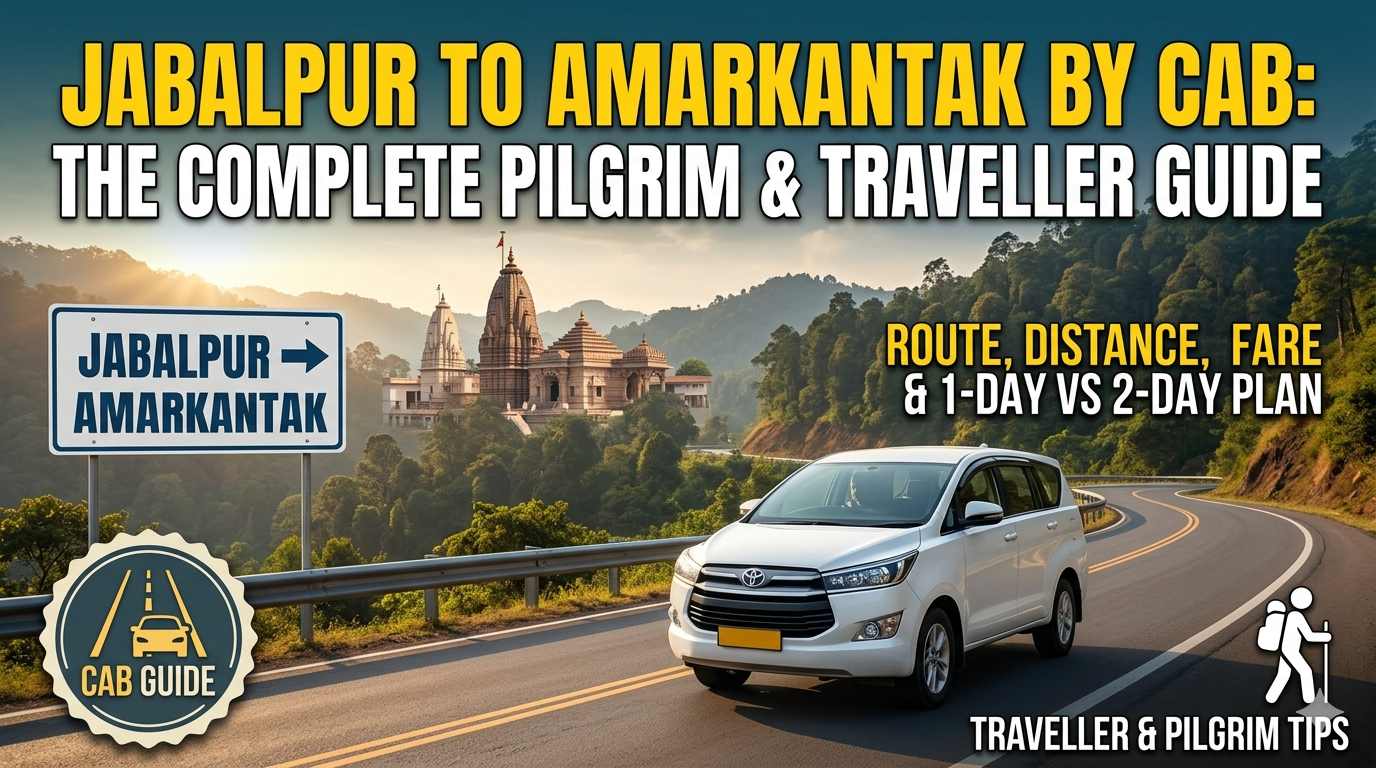
 Amarkantak is one of those rare places in India where geography and devotion meet at the same point. It is the source of the Narmada — the river that defines the spiritual map of Madhya Pradesh — and it sits quietly on the Maikal hills where the Vindhya and Satpura ranges fold into each other. For most travellers, the journey begins in Jabalpur, and the smartest, most flexible way to make that journey is by road.
This guide covers everything you actually need before you book: the real distance, which route to take, how long it takes, what a round trip by cab looks like, and how to plan a comfortable one-day darshan versus a relaxed two-day trip.
How Far Is Amarkantak From Jabalpur?
Amarkantak is roughly 220–235 km from Jabalpur, depending on the route you take. By cab, you should plan for 5 to 6 hours of driving one way, including a short tea or breakfast stop. The roads are largely single and double-lane state highways passing through forest belts and small towns, so this is not an expressway sprint — it is a scenic, steady drive that is part of the experience.
Two practical points most first-time visitors underestimate:
- The last 40–50 km is a hill climb. The ghat road up to Amarkantak is winding. A well-maintained vehicle and an experienced driver matter far more here than raw speed.
- There is no useful public transport for a same-day return. Buses are infrequent and slow, which is exactly why a private cab is the default choice for pilgrims travelling on a tight schedule.
Best Route Options From Jabalpur
There are two commonly used routes, and a good local driver will pick based on road conditions on the day:
Route 1 — via Shahpura & Dindori (the popular one) Jabalpur → Shahpura → Dindori → Amarkantak. This is the route most cab operators prefer. It is the most direct route and passes through Dindori, a convenient midpoint for a meal or a fuel stop.
Route 2 — via Mandla & Bijadandi Jabalpur → Mandla → Bijadandi → Amarkantak. Slightly longer but greener, hugging the Narmada belt for parts of the journey. Travellers who also want to glimpse the river’s mid-course sometimes prefer this.
For either route, the message is the same: this is a journey best left to a driver who runs it regularly. The road signage thins out in the forest stretches, and a driver who knows where to slow down and where the safe overtaking points are makes a genuine difference to both safety and comfort.
What to See in Amarkantak
Amarkantak rewards even a short visit. The essential stops:
- Narmada Udgam Temple — the literal source of the Narmada, the heart of the entire trip and the first place every pilgrim heads to.
- Sonmuda — the origin point of the Son river, with a sweeping valley viewpoint that is especially beautiful in the early morning mist.
- Mai Ki Bagiya — a sacred grove associated with goddess Narmada, a calm, green pause from the temple crowds.
- Kapildhara & Dudhdhara Falls — two waterfalls a short drive (and a walk) from the town, fed by the young Narmada. Best visited soon after monsoon.
- Kalachuri-era temples — the ancient stone temple complex near the Narmada Udgam, a quiet reminder of how old this pilgrimage really is.
A focused traveller can cover the core sites in half a day. A traveller who wants to actually feel Amarkantak — sit by the kund at dawn, walk to the falls without rushing — needs the better part of two days.
1-Day Trip vs 2-Day Trip: Which Should You Choose?
Choose the 1-day round trip if: You mainly want darshan at the Narmada Udgam, you are travelling with elderly family members who tire on long days but don’t want an overnight stay, and you are comfortable leaving Jabalpur very early (a 5:00–6:00 AM start is realistic). Expect a long but doable day: roughly 5.5 hours up, 3–4 hours at the temples, 5.5 hours back. You will return to Jabalpur late evening.
Choose the 2-day trip if: You want to see the waterfalls and Sonmuda properly, you want a sunrise at the source, or you simply don’t want to spend 11+ hours in a car in a single day. An overnight stay in Amarkantak (there are dharamshalas and basic-to-decent hotels) turns a hurried pilgrimage into an actual experience.
For most families, the 2-day plan is the better memory even if the 1-day plan is the cheaper one.
What a Cab Trip Actually Costs (And How Pricing Works)
Cab pricing for Amarkantak from Jabalpur is almost always quoted as a round-trip package, not per-kilometre meter fare. The final number depends on four things:
- Vehicle type — a sedan (Dzire/Etios) is the economy choice; an SUV (Ertiga/Innova) is the comfort choice for the hill climb and for groups of 5–7.
- 1-day vs 2-day — a 2-day trip adds driver night allowance and an extra day’s vehicle charge.
- Season — Narmada Jayanti, Mahashivratri, Makar Sankranti and the monsoon-end window see higher demand.
- Pickup point — airport/railway station pickups are common and usually built into the package.
Because rates move with fuel prices and the calendar, the honest advice is: get a current, all-inclusive quote before you travel rather than relying on a number you read online months ago. A clear quote should state whether tolls, driver allowance and the hill section are included so there are no surprises at the end of the trip. On Street Cab handles Jabalpur–Amarkantak as a fixed-package route, and a quick message on WhatsApp gets you the exact, current figure for your dates and group size.
Smart Booking & Planning Tips
A few things that make this specific trip smoother:
Start early — earlier than you think. The single biggest comfort upgrade for an Amarkantak trip is leaving Jabalpur by 6:00 AM. You climb the ghat in good light, reach the temple before the mid-day crowd, and you are not racing darkness on the return.
Carry cash. Amarkantak is a hill pilgrimage town. UPI works in many shops now but not reliably everywhere, and not for every small temple offering or local guide.
Book accommodation before you leave for a 2-day trip. Rooms in Amarkantak are limited and fill fast around festival dates. When you reserve a hotel or dharamshala online, you’ll usually have to hand over an email for the confirmation. For a one-off booking on a portal you’ll never use again, many regular travellers simply use a throwaway email address so the trip confirmation lands somewhere accessible without their main inbox filling with months of promotional mail afterwards. Small habit, genuinely less spam.
Confirm the driver knows the route. This is non-negotiable for the ghat section. An experienced Jabalpur driver who runs the Amarkantak route regularly is worth more than the cheapest quote you can find.
Plan your stops. Dindori is the natural breakfast/tea halt on the popular route. Tell your driver in advance if you want a proper sit-down meal versus a quick chai so the timing works around temple hours.
Combining Amarkantak With Other Trips
Many travellers don’t treat Amarkantak as a standalone trip. From Jabalpur, it pairs naturally with:
- Bhedaghat & Dhuandhar Falls — done as a separate short trip before or after, since it’s close to Jabalpur itself.
- Kanha or Bandhavgarh — wildlife circuits that combine well into a longer 4–5 day Madhya Pradesh itinerary by road.
- Maihar (Sharda Devi) — for pilgrims doing a wider temple circuit through the region.
A good cab operator can stitch these into a single multi-day plan with one vehicle and one driver, which is far less stressful than rebooking transport at every stop.
A Note for Travel Creators and Trip Planners
Amarkantak is increasingly popular with travel vloggers and slow-travel bloggers — the source-of-a-river story is genuinely compelling content. If you’re documenting the journey and finally giving your travel page or channel a proper identity, it’s worth spending ten minutes with an AI name generator before you settle on a handle; a distinctive, available name early on saves a painful rebrand later when the audience starts growing. It’s a small step, but creators who sort their branding before the trip almost always wish they’d done it sooner.
Final Word
Jabalpur to Amarkantak is one of the most rewarding road journeys in central India — a 220-odd kilometre arc that ends at the literal birthplace of the Narmada. Whether you do it as a determined one-day darshan or a calm two-day retreat, the difference between a stressful trip and a memorable one comes down to two decisions: how early you start, and how reliable your vehicle and driver are.
Plan the route, set the alarm early, get a clear all-inclusive quote for your dates, and let the road do the rest. The river has been waiting at the top of that hill for a very long time. It’s worth arriving unhurried.
To get current Jabalpur–Amarkantak package rates for your travel dates and group size, message On Street Cab directly on WhatsApp at +91-9827449020.